
 Ask any teacher who follows the common core (CC) curriculum and they will tell you that the old fashioned “algorithm” of borrowing and carrying is too prone to mistakes, no one understands it and it doesn’t teach placement value of numbers. For full disclosure, I haven’t interviewed every teacher of CC, but the teachers I’ve interacted with and websites I visit say the same thing.
Granted, borrowing and carrying is difficult to understand but the CC answer borders on insanity, here’s a video describing their methods: http://www.youtube.com/watch?v=xVqqPwhZRDs. On the video they missed the CC strategy of having a kid count on their fingers and toes (and for really big numbers, their neighbors fingers and toes)!
While I understand all of the methods and what they are trying to teach, I’ve also seen the effects of teaching a second grade kid three, four or five different methods to solve an equation; they don’t really understand any of them. Confusion, frustration, anger, hopelessness…and those are just my emotions when forced to solve a simple equation with multiple CC methods, you should see Sara’s list of emotions!
Plus it’s simple statistics, the more calculations they do, the more prone to error the calculation becomes. As you saw in the video, some of the methods have exponentially more calculations than the “old fashioned” way.
What’s a summer homeschooling dad to do?
Let’s look at the end goal. Sara needs to be able to carry since the crazy CC methods aren’t scalable to large numbers and because there are too darn many “strategies”. So let’s figure out one (uno, ein, ichi, um) method that teaches placement value and the concepts behind carrying. We’ll call it carrying with training wheels. When Sara is steady, we can take off the training wheels and viola, she will be able to solve large equations and still understand what she’s doing.
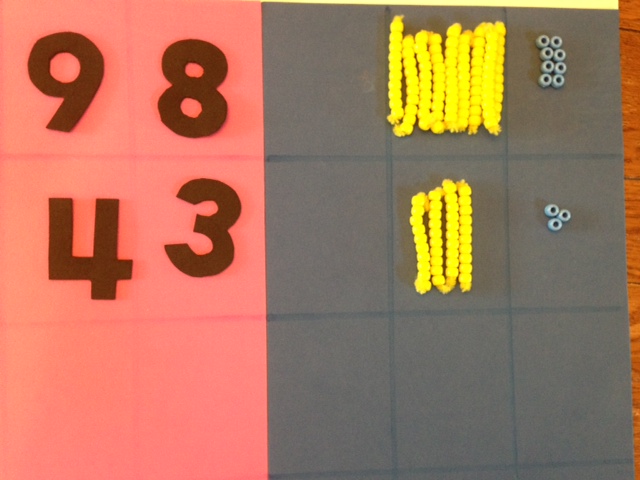
Tonight I put this concept into action and called upon my ever-trusty Mil Board. As you can see in the picture above I created an addition problem of two-digit numbers. Sara then represented those numbers with beads (10-string and singles). Next we trade in 10 singles for a 10-string, then 10 10-strings for a 100-block. The answer is represented in the picture below:
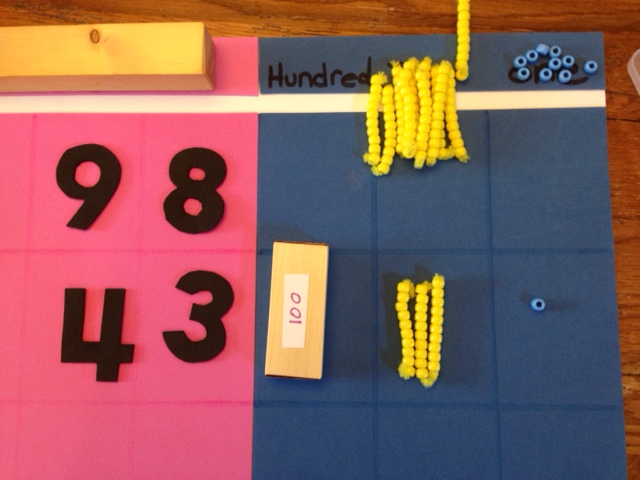
As with any learning, you have exposure, understanding then mastery. Sara was able to manipulate the beads properly for a few equations which is good enough for exposure. We’ll keep working on the method over the next week or two..I’ll let you know how/if we get to understanding.
_____
“For God is not the author of confusion but of peace.” 1 Corinthians 14:33
 Daddy's Daze
Leave a comment
Comments feed for this article